Showing posts with label Storytelling. Show all posts

Wednesday, November 5, 2014

Storytelling Week 12: Twenty Two Goblins

"Son, take a seat so I can tell you a story that has been passed down through our family for generations" said the boys grandfather.

He thought to himself, here we go again, grandpa's got another wild story that will go for days and eventually have no point to it. However, he did as his grandfather had instructed him, taking a seat on the couch.

"This is the story of Twenty Two goblins, an ancient tale telling of the trials and tribulations of King Victory" said grandpa.

A very long long time ago there was a great King named Victory. His name was quite fitting seeing that he had never been defeated in battle and his kingdom was the most renowned in the land. Each day the king received a single piece of fruit from a weary monk, never speaking a word, juts handing over the fruit and then returning to wist he came from. The king never thought anything of it until one day a wild monkey had wandered into his palace just as the monk had given him the fruit. The king being a generous man gave the papaya to the monkey who split it open only to reveal a large ruby lying within. The king quickly asked his treasure what he had done with the rest of the fruit, they rushed to the storage room and quickly found that each and every piece held a beautiful gem. The king instantly assembled his men to go and fetch this ever so gracious monk for him. Upon his arrival the monk informed the king that he needed his help and that is why he always presented him with the fruit. The king agreed to help the man and met him later that night under a fig tree outside the city walls. The monk then explained what it was that he wanted from the king. He asked that the king trek through the cemetery to the far side where in the tree would be hanging a dead man. He asked that the king bring the dead man to him. The king being a man of his word agreed and headed off in the direction of the tree.

As he came out of the far side of the cemetery he found the man rung by his neck hanging from the tree. He swiftly climbed its branches to cut the man lose. With one foul swoop he sliced through the rope and the man crashed to the dirt. However, unlike most dead men, this one grimaced and winced as if he had actually felt such a fall. The thought that he must be hearing things and proceed to pick up the body. As he did so the mans head rotated in his direction and began to speak to him. Unaware of how this could be possible the king began asking the man various questions which he however, refused to answer. The king had only once heard of such black magic but thought it only to be a myth. What he had heard was that a goblin and only a goblin could take over the body of the dead, he assumed that this is why the monk needed this man, to banish this dark creatures back to his hole and free this mans poor soul. As they walked along the goblin asked the king if he liked stories, especially ones with riddles embedded throughout. The king, thinking himself to be quite the intellectual told the goblin that never has there been a riddle that he couldn't solve. The goblin took this remark as a challenge and began to tell his first story of the night. He told the king that he must answer the riddle if he does in fact know the correct answer, if he doesn't do so then his head will explode. There was also the small stipulation that if in fact the king was correct in solving the riddle then the goblin would be put back in the tree and the king would once again have to fetch him. And so a long night of exchanges began between the goblin and the king, each trying to outsmart the other and each having a secret agenda of their own.
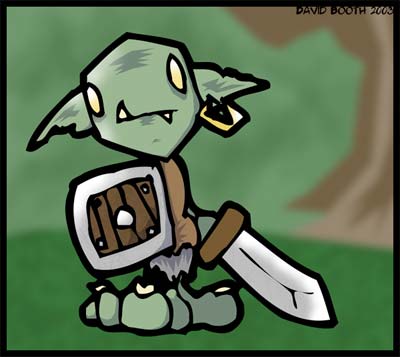
Amusing Goblin 

Author's note: This story comes from the un-textbook reading of Twenty Two Goblins. It was quite challenging to actually retell any of the stories because they are written very well and already provide a lot of detail. I did however decide to rewrite the introduction and added a few small parts to it. If you would like to read any of the stories they are all summarized (in a lot of depth) in my reading diaries and there are also links to the originals.

Thursday, September 25, 2014

Storytelling, Week 6: The Story of Mankanaka: Final

When almost always surrounded on all sides by the eruption of lush green grass, why is it then that we just let it lie and leave it to be consumed by animals? One would think that such a resource ought to be utilized by the likes of men. However, there once was a man who only indulged himself with heaping piles of grass, never straying from the consumption of the sweet savory stalks. This is the story of Mankanaka and his power over the world.

Mankanaka was a common man, choosing to live a spiritual life within the forest, always trying to find a path towards enlightenment. From a young age, Mankanaka believed that the best way to achieve his goal was to truly become one with nature, never taking the life of another and only eating what the Earth provided to him. This idea started off well for him, but after some time the man developed a taste for only one item in the world. He loved the taste of grass and the spirituality that he believed it brought to him. In the spring the grass was a vibrant green, tasting sweet and succulent. In the fall it began to brown, giving it more of an earthy quality in both taste and appearance. In the winter Mankanaka had to find ways to rejuvenate the grass that was now dried out and brittle, most often stewing it back to life. The changes in seasons continually kept Mankanaka on his feet, never growing tired of the taste of grass. One day while he was in a field of tall grass, harvesting his lunch, Mankanaka accidentally swung his sickle a little too far and gashed his left arm. Expecting to see a red gush begin to flow, he was quite surprised when instead of red, a green fluid began to drip out. Wondering what exactly was occurring, he dipped the tip of his finger into the substance and tasted what lay below. To his amazement, the substance tasted exactly like the grass he was surrounded by. He became enamored with this realization and began to dance around in pure bliss, believing that he had finally achieved true enlightenment. Other creatures and people began to notice Mankanaka's happiness and followed in the pursuit of his joy. All began to dance and all became enthralled with joy. As this occurred, the gods began to notice what was happening down on Earth. The world was beginning to spin violently out of control and the only hope of stopping it was to end the dancing of Mankanaka. Shiva was sent down by the gods to do so.

As Shiva approached Mankanaka, those around him began to stop dancing, enchanted by the beauty and power of the god. Mankanaka, however, didn't even notice the presence of Shiva and continued to rapidly spin round and round. As with a coin spinning on a table, Shiva quickly and abruptly placed a finger atop the head of Mankanaka and stopped him in his tracks. As he looked the god in the eyes, he knew that he had created trouble in this world. Shiva explained to him what it was that he was doing and that if he continued his dancing, the end of the world would come at the movement of his feet. Then, just as quickly as Shiva had appeared, the god was gone and all eyes were on Mankanaka. He told all to go away and he returned to his quest for enlightenment, only sometimes indulging in his favorite feast of springtime grass.

Shiva, The Savior of Mankanaka 
Source: Wikipedia

Author's Note: This is based off of The Story of Mankanaka, a tale in the Mahabharata written by Buck. In this tale, Mankanaka only eats grass, which causes him to bleed a green substance. This causes his happiness and continual dancing that disrupts the Earth. His dancing threatens to destroy the world so the gods send Shiva to attempt to stop his actions. Unlike the original story I have Shiva come to Mankanaka in his true form because I believe it better conveys the seriousness of the issue and his power to those dancing. Also, in the original story it is ash that flows from Shiva's veins when he is cut to show his power to Mankanaka. I thought that having the grass ooze out from Mankanaka better exemplified the connection he had to nature and the amount of grass he had consumed. I chose this story because it revolves around food, a very common topic within the Indian epics. I plan to continue finding stories with aspects of food lying within them and further elaborating on this topic. I will also begin to add various recipes for Indian dishes that I have found along the way well researching this topic. Food, as in most cultures, plays an important role in not only to the history of India but also because of the impact it plays religiously. As I continue on with this story theme I would begin to add various culture tips and/or fun facts regarding their food culture. The Story of Mankanaka was a very basic start of the stories that I hope are to come continually improving on the content and knowledge that will be passed unto the readers.

Buck, W. (1973). Mahabharata. University of California Press.

Monday, September 22, 2014

Storytelling: Jatayu (Final Revision)

Frantically they searched the forest, looking for any sign that may lead them to Sita's captor. They began to find pieces of armor, larger than any man could wear yet sliced clean through like warm butter. Next came an axle shooting straight out of the ground and erupting through the canopy, greatly taller than any tree. Then there it was - through the trees Rama could make out the shape of what he thought to be a bird but like none he had ever seen before. Unaware of whether this beast would be friend or foe, Rama and Lakshamana slowly crept through the tree line in an effort to conceal their movement. As they broke through the final branches, towering above them laid Jatayu, the bird king. He was the most magnificent thing either of the men had ever seen, pure white with a feathering that looked like silk. He had a sort of sheen about him that illuminated the leaves all around almost like a beacon in the middle of a churning sea. However, as they moved closer, they began to realize that Jatayu was badly injured. They began to piece together the clues, assuming that this great beast must have been the one responsible for the shredded armor and wagon pieces scattered throughout the forest. Jatayu turned to Rama with an unbreakable gaze and said, "I am Jatayu, king of the heavens and all those who fly within it. I tried to save your wife from the demon king but my old age has weakened me. We fought one another across the heavens but just as victory was in sight, I was fooled by my own doing; it looked as though I had removed Rama's arms but they grew back as I was focused on his ten heads. This is when he struck his final blow, parting my wings from my body, watching me plummet to this very spot. Will you help me to pass onto the next world and if granted, return to you one day in your debt?"

Rama was saddened to see this great hero pass, but knew that it was his duty to fulfill the wishes of Jatayu and give him a proper funeral. Rama and Lakshamana began to cut down nearby trees and build a pyre around the dying king. Rama took off his meager robes and draped them over the king to represent their newly created bond and Jatayu's sacrifice. The pyre was so great in size that it took the two men the remainder of the day to finish it, completing it just as the golden sun began to sink beneath the western shore.
Just as Rama was to light the pyre, Jatayu once again caught his gaze and forced out his final words, "You will find her; never lose hope."

Rama dropped the torch after hearing this and the pyre caught ablaze. It glowed with a beauty that only further reminded him of Sita and her golden brown skin. As he looked away, holding back tears, something strange began to happen. The fire began to engulf Jatayu and beat almost as that of a bird’s wing. It then began to change colors, first a subtle orange, then a vibrant yellow, and finally a blistering red. Out of the flames rose the spirit of Jatayu, reborn once again. As he took flight out of the flames, Rama knew that this would not be his last encounter with Jatayu; when needed, he would appear to fulfill his promise.


     Ravana and Jatayu in Battle 
(Source: Wikipedia )


Author's note: This is my take on the funeral of Jatayu and a more in-depth look at the events that may have occurred during this time. The stories of Jatayu and his brother Sampati are some of my favorites within the epics but I feel that they are often skimmed through and not given the amount of detail that they deserve. The battle that occurs between Ravana and Jatayu is another example of a lacking portion and I especially felt the shortage during the funeral of Jatayu. This character represents everything that is good in the world and lives only to benefit the lives of those around him. He is then murdered by the ruthless demon king, Ravana, trying to prevent the capture of Sita and return her to her lover, Rama. Such acts of selfless bravery deserve to be spoken of and the funeral of such a being ought to be adequately represented. This is why I chose to rewrite this story and embellish it in the ways in which I felt appropriate. I focused primarily on the use of colors in order to add visual detail and hopefully help the readers to better picture the scene for themselves. I also wanted to show the magnificence that comes to mind when I read about the bird king, Jatayu, by better describing his features and the general presence that he has.   

Buck, William. "The Golden Deer." Ramayana. Los Angeles: U of California, 1976. 173-175. Print.

Wednesday, August 20, 2014

Week 1 Storytelling: The lion and the mouse

As the king of the jungle slept one night he was roused from he sleep by the slightest of brushes. Unaware of what may lie in front of him the lion slowly peaked open his eyes only to find but the smallest of mice. For the split second that the creatures stared eye to eye they both pondered on their next move. The lion swiftly pinned the mouse to the ground while she began to plead for her life. She begged the lion to let her live, telling him that one day he would be repaid for his mercy. Although the lion doubted this promise never the less he released the mouse. He later thought to himself that he had made a mistake but this thought quickly left his mind as he drifted back to sleep. Weeks later the lion crept through the brush stalking his prey when he become ensnared in a hunter's trap. He roared in dismay as he attempted to break free but even with all his might was unable to do so. The mouse however recognized that roar, she scrambled towards it hoping to repay her debt. She found the lion defeated and exhausted, he could barely even acknowledge her presence by the time she arrived. The lion lay drenched and held taught by multitude ropes. The mouse took a moment to weigh her options and decided what she could best do to help.  She began to tear at the ropes, strand by strand and slowly but surely made headway. She finally broke the lion out, exploding upward with a sigh of relief. He finally realized that no matter how small or large, help could come in any form. He also learned to not judge a book by its cover but to look deeper into their true being.


The Lion and the Mouse (Original)
A lion and a mouse come into contact with one another and to spare her life the mouse promises to one day help the lion. The lion doesn't believe that he could ever require the help of such a tiny creature but in the end will realize that all shapes and sizes serve an important purpose.